Building Profit Resilience Through Better Data
Welcome to the wild world of ecommerce, where the only constant is change! If you’ve been paddling in the digital market long enough, you’ve surely learned this truth: running a successful online store is more akin to steering a ship through the constantly shifting seas rather than strolling through a quiet, stable, and predictable park. This means your ability to swiftly react to changing tides and wind patterns — figuratively speaking, of course — defines your path toward or away from Treasure Island. 🏝
How, you might wonder, can a humble captain manage such a feat? The compass, map, and sextant of ecommerce lie in harnessing powerful data. Understanding and interpreting this data effectively ensures you’re not just surviving but thriving — achieving what we like to call “profit resilience”. Let’s embark on this treasure hunt where X marks the spot of enhanced data effectiveness. Ready, matey?
The Treasure Map: Understanding Profit Resilience in Ecommerce
Profit resilience is your business’s ability to maintain and increase profits despite obstacles like market volatility, competitive pressures, and economic fluctuations. It’s like having a ship so well-built and well-run that it can handle both gentle breezes and fierce storms with equal finesse.
To build this kind of resilience, you have to look below the deck — into the hold where your treasure trove of data lives. But simply having data isn’t enough; you need to understand and use it strategically to inform decisions across every aspect of your operation.
Digging Deeper: Key Data Types for Profit Resilience
We aren’t just reading the stars anymore; we’re using sophisticated tools to navigate. For WooCommerce store owners, here are the main data types you need to analyze deeply:
- Sales Data: Tracks revenue trends, best-selling products, and patterns in buyer behavior.
- Customer Data: Understands who your customers are, their buying habits, and their lifetime value.
- Operational Data: Evaluates your business operations, looking at shipping costs, supplier performance, and inventory levels.
- Financial Data: Keeps an eye on the flow of money, covering areas such as cost of goods sold (COGS), operating expenses, and profit margins.
- Marketing Data: Measures the effectiveness of your marketing campaigns, including paid ads, email marketing, and social media engagement.
But here’s the snag — having piles of data is like having a map without knowing how to read it. The real skill lies in turning mere numbers into actionable insights that steer you towards higher profitability and resilience.
Charting the Course: Strategies for Data-Driven Decision Making
1. Integrating Your Data Sources
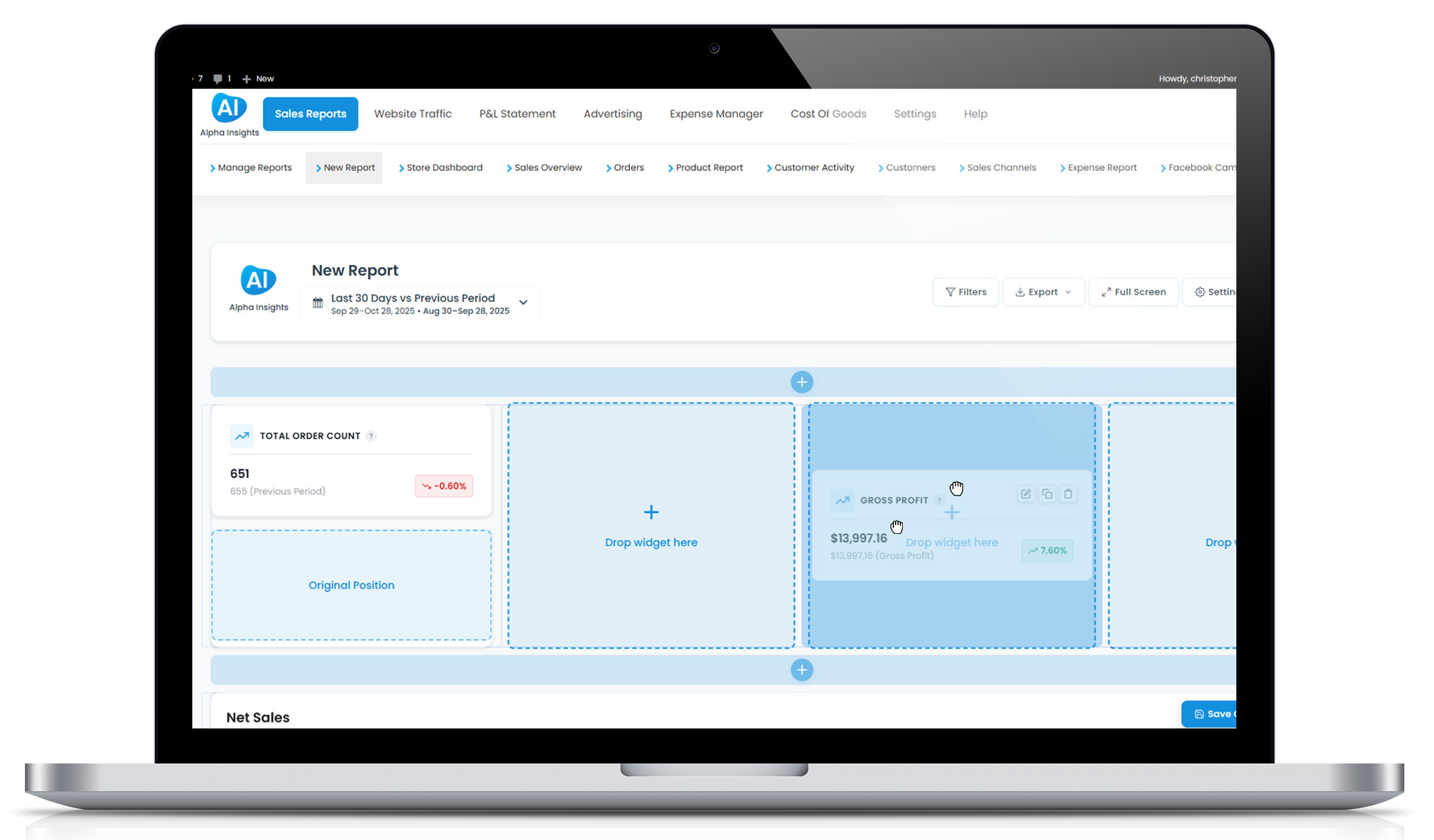
Imagine trying to navigate using charts from different eras — confusing, right? The same goes for managing data from disparate sources. Integrating your ecommerce, customer relationship management (CRM), and back-office systems gives you a comprehensive view of your business landscape. Tools like Alpha Insights can be your all-seeing spyglass here, helping you view all crucial metrics in one place.
2. Focusing on Key Performance Indicators (KPIs)
A savvy captain knows which stars to guide them. Identify KPIs that genuinely reflect your business health and growth potential. These could include Conversion Rates, Average Order Value, Customer Acquisition Costs, and more. By tracking these metrics closely, you can make better decisions about where to invest your resources.
3. Predictive Analytics
This is like having a fortune teller on board. By analyzing past and current data, predictive analytics tools help forecast future trends and behavior, thus allowing you to prepare better for what’s ahead. Whether it’s anticipating a surge in demand or identifying potential cash flow gaps, these insights can be invaluable.
Navigating Challenges: Building a Data-Driven Culture
For data to truly be beneficial, it needs to be rooted deeply in the culture of your organization. This means ensuring that everyone from the deckhand to the first mate understands the importance of data and is involved in collecting, analyzing, and acting on insights.
Encouraging Team Participation
Every member of your crew has a unique perspective and can offer insights into improving processes or understanding customer needs better. Encourage a culture where data is openly shared and discussed, and where every team member feels empowered to suggest changes based on real data.
Continuous Learning and Improvement
The seas of ecommerce are ever-changing, and so should your approach to data. Continuous learning about new data tools, techniques, and strategies is vital. Engage with communities, attend webinars, or explore new plugins like Alpha Insights that can provide new ways of seeing information.
Conclusion: X Marks the Spot
Building a resilient profit structure in your WooCommerce store isn’t just about bracing for the storms but adapting and thriving in them. It starts and ends with data — how you collect it, analyze it, and act on it. By fostering a robust data-driven culture, integrating your data sources with tools like Alpha Insights, and focusing on predictive analytics, you’re not just surviving; you’re charting a course toward a treasure trove of business successes.
Now, let the stars guide you, but remember— it’s your hands on the sextant and your eyes on the horizon that will lead you to prosperity!