Unlocking the Secrets of Financial Momentum in WooCommerce
Ever watched a skateboarder suddenly speed up down a slope? That’s momentum at play, a vital concept not only in physics but also in the bustling world of e-commerce and, more specifically, within your WooCommerce store. While physical momentum can be visibly exciting, financial momentum isn’t less thrilling. If you know how to measure it, that is. Hang tight; you’re about to discover how to quantify your WooCommerce shop’s speed and direction in financial terms, ensuring you’re not just rolling along but actively steering towards profitability.
Understanding Financial Momentum
First off, what do we actually mean by financial momentum? It’s essentially the measurement of your store’s financial performance over time. Think of it as a snapshot of whether your business speed is increasing—like revenue growth—or decreasing, perhaps through accumulating costs. The trick is knowing what to measure and how to interpret those figures to sustain or regain your desired business trajectory. Remember, the goal here is to maintain a healthy acceleration, not just any movement!
What to Measure in WooCommerce
To get a good grip on your financial momentum, a deep dive into some core metrics is essential. Let’s break it down:
Revenue Trends
Revenue is the top line of your financial dashboard and one of the primary indicators of business health. Analyzing patterns in your revenue helps detect growth spurts and slowdowns, which are crucial for assessing your store’s momentum. Look at:
- Daily, weekly, and monthly sales figures
- Year-over-year growth
- Seasonal impacts or the influence of promotions
Each revenue snapshot can tell you a lot about which direction your skateboard—err, business—is heading!
Profitability Ratios
Revenue is great, but it doesn’t give the full picture without considering costs. Assess profitability through metrics like:
- Net profit margin: Revenue minus costs
- Gross margin: Revenue minus the cost of goods sold
- Operating margin: How much profit you make on a dollar of sales after paying for variable costs of production
Improving these ratios often indicates gaining financial momentum, as your store is not just earning more but also managing resources more efficiently.
Customer Acquisition Cost (CAC) and Customer Lifetime Value (CLV)
To sustain long-term growth and momentum, understanding your customer acquisition costs (CAC) relative to the lifetime value of those customers (CLV) is critical:
- Calculate CAC by dividing all the costs spent on acquiring more customers (including marketing expenses) by the number of customers acquired
- Calculate CLV by multiplying the average purchase value by the average number of times a customer buys in a year
A lower CAC coupled with a higher CLV is like catching a strong, sustained gust of wind, propelling your store forward.
How to Track These Metrics in WooCommerce
Measuring these financial metrics can seem daunting, but thanks to modern tools, it’s more accessible than ever. In WooCommerce, several methods can help you effectively track this data:
Native WooCommerce Reports
WooCommerce comes equipped with basic reporting tools that offer insights into sales, customers, stock levels, and taxes. These reports are a good starting point for understanding your store’s financial performance.
Advanced Analytics Plugins
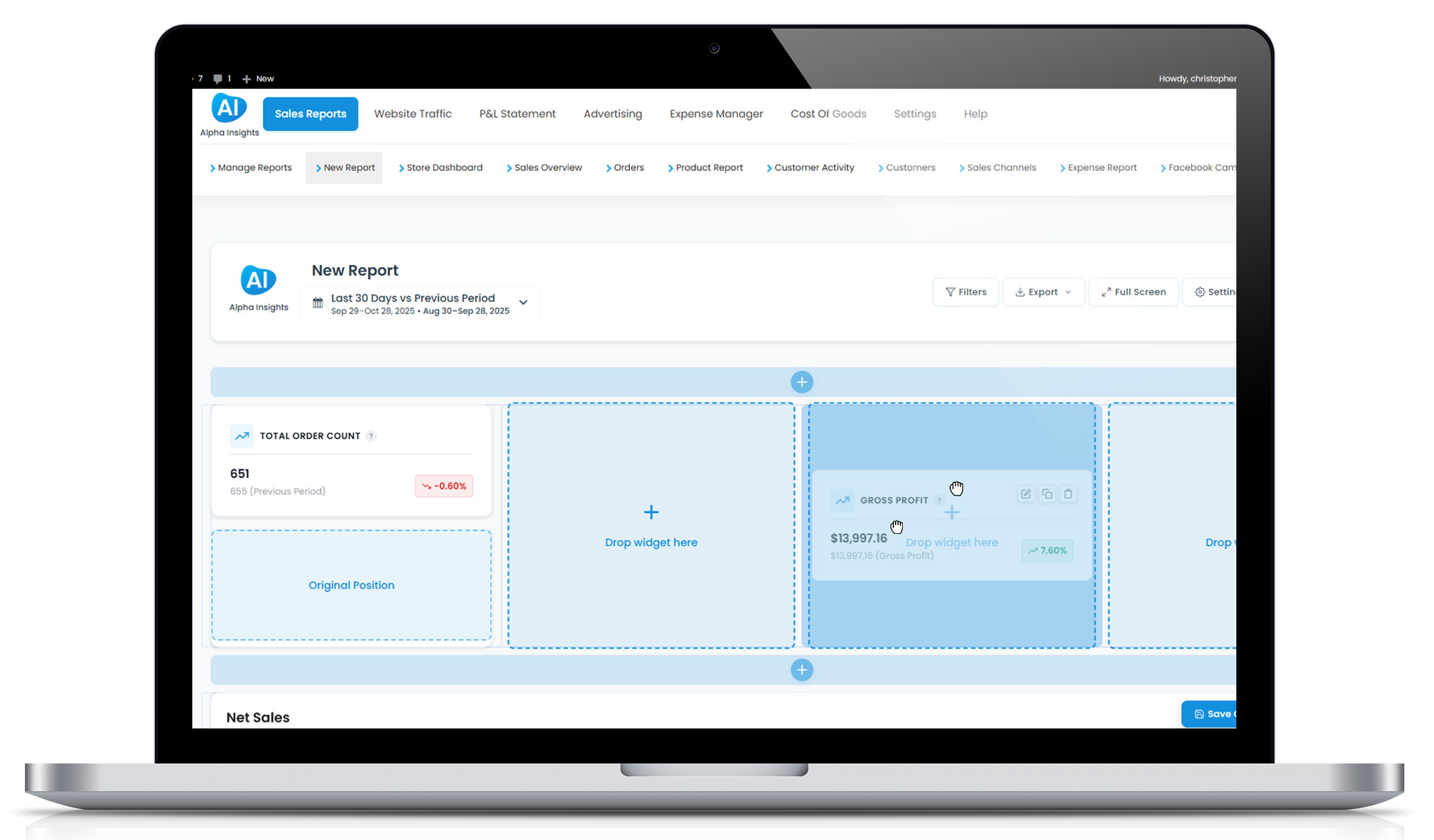
For deeper insights, advanced analytics plugins can be game-changers. Plugins like Alpha Insights offer specialized tools to drill down into your data and understand your financial momentum comprehensively. With features tailored to measure and analyze everything from revenue trends to profitability ratios, these tools provide a clear lens on your business trajectory.
Using a robust solution like Alpha Insights not only gives you access to real-time analytics and historical data comparisons but also helps identify patterns and anomalies that you might miss otherwise. This level of detailed reporting supports strategic decision-making and steers your WooCommerce store towards sustained financial growth.
Action Steps to Utilize These Insights
Knowledge is power, but actionable insights are the superpower of the WooCommerce world. Here’s how you can use the data you gather:
- Analyze trends regularly to anticipate changes in your store dynamics.
- Optimize marketing spend by understanding the relationship between CAC and CLV.